Predictive population health modelling is a leadership capability
Historical activity describes the system an organisation already has. Predictive modelling helps leaders understand—and shape—the system their population will need.
Published
By Glen Johnston
Predictive population health modelling should not be treated as an analytics project. It is a leadership and planning capability.
Many health systems still make major decisions using historical activity: how many patients attended, how many procedures were completed, and how much was spent. These measures matter, but they describe the system that already exists.
Designing around future population need
Predictive modelling helps leaders understand the system they will need. Its value comes from connecting future population need to the strategic, operational, and investment decisions that can change the trajectory.
- Population growth and demographic change
- Disease prevalence and future risk
- Preventable demand and care gaps
- Workforce and clinical capacity
- Hospital, primary care, and community infrastructure
- Cost, funding, and investment priorities
- The expected impact of alternative interventions
The real value is better decisions
The aim is not simply to produce a more sophisticated forecast. It is to help leaders make better choices: whether to add capacity or prevent demand; whether to invest in another facility or strengthen primary care, screening, and chronic disease management; and where workforce constraints or deteriorating population risk require earlier action.
Predictive population health modelling creates a bridge between population need, strategic choices, and operational delivery.
The model alone is not enough
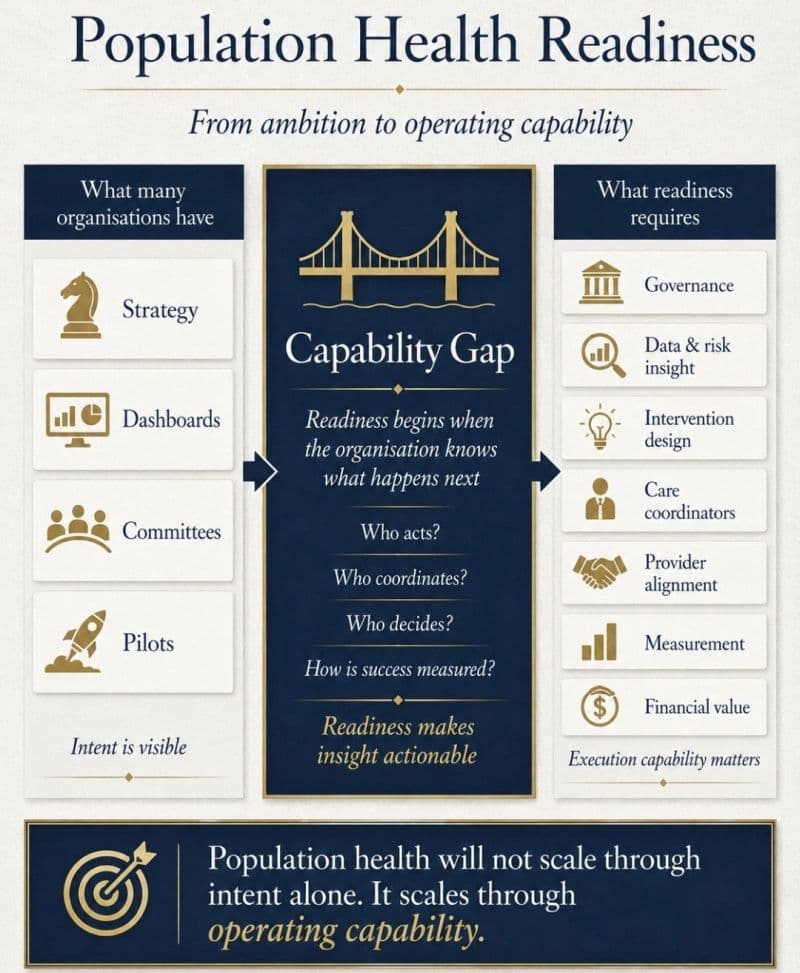
Insight creates value only when the organisation has the capability to act on it. Leaders still need five foundations:
- 01Clear decision rightsDefine who is authorised and expected to act on the insight.
- 02An accountable operating modelEstablish which team owns delivery and the outcome.
- 03Scenario planningTest what changes under different assumptions and interventions.
- 04Integrated executionAlign providers, payers, and community partners around the response.
- 05Continuous measurementDetermine whether the intervention changed the predicted trajectory.
A practical opportunity for GCC health systems
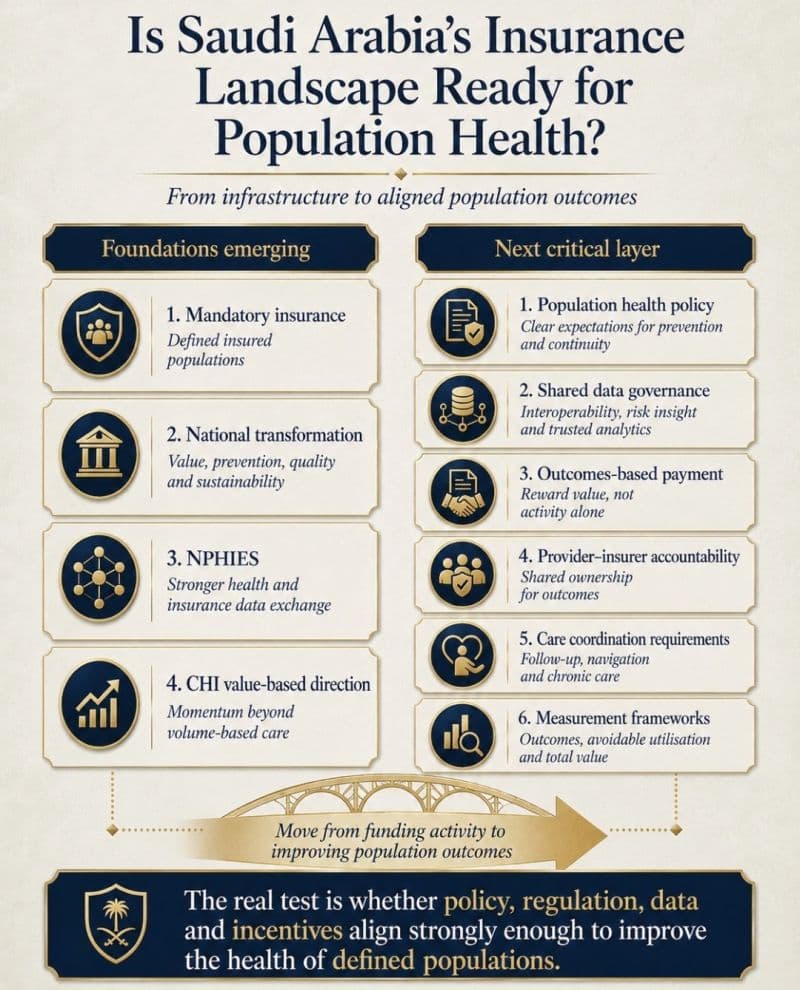
For healthcare leaders across Saudi Arabia, the UAE, and the wider GCC, the opportunity is to move beyond planning services around historical utilisation and begin designing systems around future population need.
Without the leadership foundations above, predictive modelling becomes another dashboard. With them, it becomes a practical tool for health-system transformation.
The leadership question
What decisions must we make today to change that future?